 EN
EN

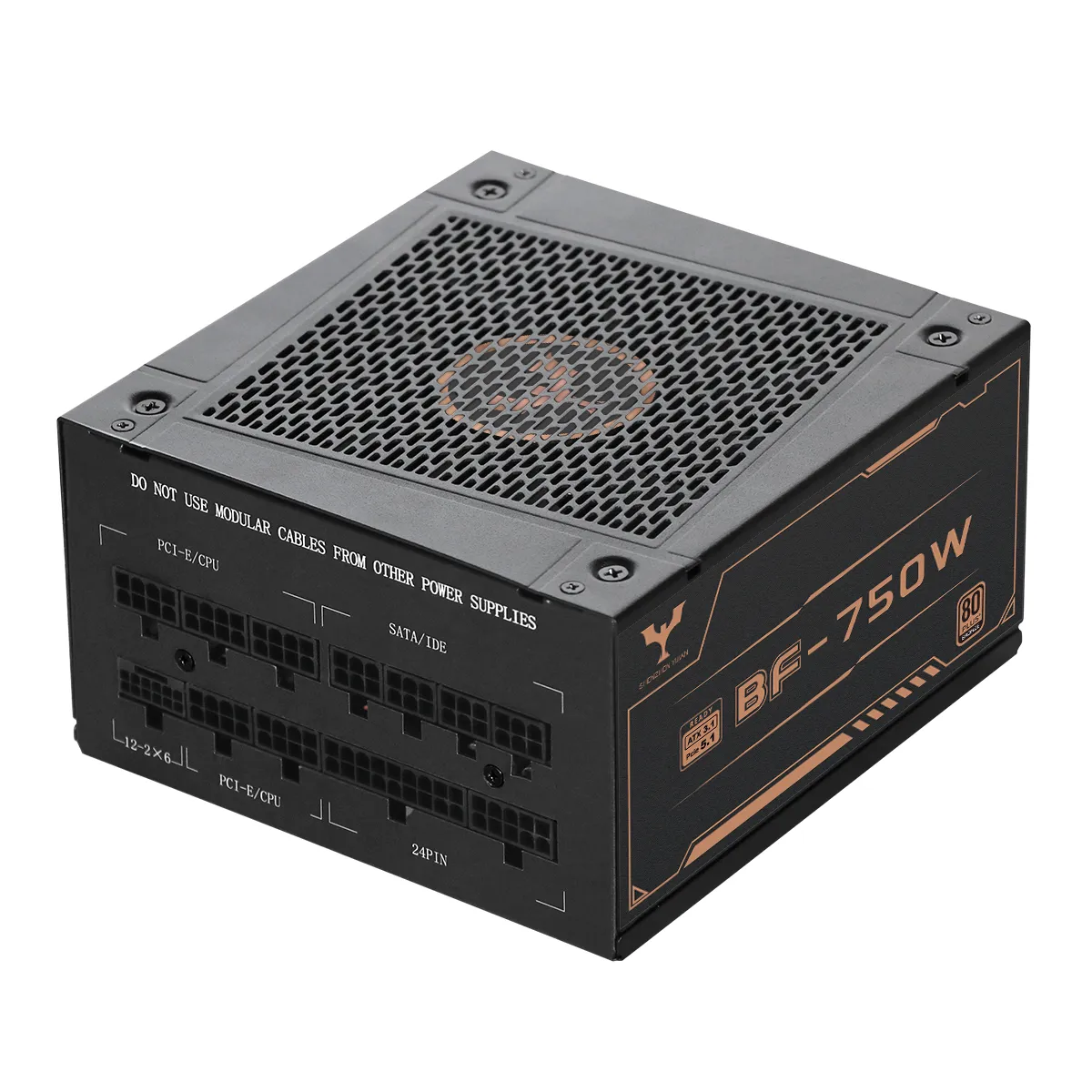
What Efficiency Rating Means for a 750W PSU
A 750W power supply does not draw 750W from the wall. The actual AC input draw depends on the efficiency at that moment's load. If a 750W unit is certified at 80Plus Gold and operates at 80% efficiency under a 50% load (375W DC output), the wall draw equals approximately 417W. At 90% efficiency under the same load, wall draw falls to roughly 417W as well — actually 375 ÷ 0.90 = 417W for 80Plus Gold, versus 375 ÷ 0.82 = 457W for 80Plus Bronze. Over a machine running 8 hours per day, 250 working days per year, that gap is approximately 100 kWh annually per unit — meaningful at scale. This is why specifying the efficiency grade matters, not just the rated wattage.
The 80Plus Tiers Relevant to 750W Supplies
The 80Plus certification body defines minimum efficiency thresholds at 20%, 50%, and 100% of rated load. For a 750W unit, these loads correspond to 150W, 375W, and 750W DC output. A 750W power supply at 80Plus Bronze must achieve at least 82% at 20% load, 85% at 50% load, and 82% at 100% load. A 750W unit at 80Plus Gold must achieve 87%, 90%, and 87% respectively. A Platinum-rated 750W model reaches 90%, 92%, and 89%. The 50%-load figure — the most frequently cited — is where units spend the majority of their operational time in typical desktop use. For buyers procuring 750W units at volume, specifying Gold or above ensures the units operate near 90% efficiency during standard workloads, not just under ideal lab conditions. Yijian's product range includes an 80Plus Gold GTJ-750W Full-Modular ATX PSU as part of its Gaming and Desktop Power Supply line, demonstrating that this efficiency tier is achievable at the 750W class.
Circuit Topology and Its Effect on Efficiency
Not all 750W power supplies with identical certification labels deliver equivalent performance. The internal topology determines how consistently efficiency is maintained across load fluctuations. A two-transistor forward topology — common in lower-cost units — achieves acceptable efficiency at mid-load but tends to drop off at partial loads. LLC (inductor-inductor-capacitor) resonant conversion, combined with synchronous rectification and DC-DC regulation for the +3.3V and +5V rails, maintains higher efficiency across a wider load range. Yijian's designs use LLC resonance combined with synchronous rectification and a DC-DC converter stage — the same topology employed in their 80Plus Gold certified 850W Gaming Power Supply and their 1000W ATX unit. For a 750W class unit using this topology, buyers can expect more consistent efficiency between 20% and 100% load, reducing efficiency penalties during partial load operation common in everyday desktop use.
Active PFC and Its Relationship to Efficiency
Active Power Factor Correction (Active PFC) is a design feature closely tied to efficiency, though they are not the same measurement. PFC corrects the phase relationship between AC voltage and current, reducing reactive power consumption and improving the quality of the load presented to the grid. Units with Active PFC typically achieve a power factor of 0.95 to 0.99 — meaning nearly all drawn AC power is converted to usable work. Non-PFC or passive PFC designs have power factors of 0.65 to 0.75, meaning a larger proportion of AC input is wasted as reactive power that contributes to utility billing in commercial settings. Yijian's power supplies incorporate Active PFC across their Gold and Platinum product lines, supporting compliance with European ErP Lot 3 efficiency requirements and providing a more stable power environment for sensitive computing hardware.
Thermal Management and Efficiency Retention Over Time
A 750W power supply's rated efficiency is measured at defined test temperatures. In real-world deployments, thermal load from the surrounding chassis environment affects how the PSU sustains that efficiency. A 12CM hydraulic bearing fan that automatically adjusts speed based on load — remaining near-silent at low loads and ramping up only when necessary — is preferable to a fan that runs at constant high speed, generating unnecessary heat recirculation inside the unit. Yijian's product line specifies 12CM intelligent temperature-controlled hydraulic fans with noise below 30 dB(A) at 40°C full load. Additionally, I-STOP (one-touch fan start-stop) functionality allows the fan to remain off when loads are very low, reducing thermal stress on the fan bearing over thousands of operating hours. For buyers, this detail is relevant to mean time between failure (MTBF) projections rather than just audio comfort.
Capacitor Quality and Long-Term Efficiency Stability
Efficiency is not only a certification result at the time of manufacture — it is a characteristic that degrades if internal components deteriorate. Electrolytic capacitors are particularly susceptible to thermal aging: lower-rated capacitors lose capacitance and increase ESR (equivalent series resistance) over time, introducing ripple and loss into the output rails. Using 105°C-rated Japanese capacitors from established brands such as RUBYCON, NIPPON CHEMI-CON, or NICHICON — as Yijian specifies for its units — extends the period over which the PSU maintains its rated efficiency characteristics. Buyers procuring 750W units for multi-year deployments should confirm capacitor temperature rating and brand pedigree in the datasheet or by requesting component disclosure from the supplier.
Practical Sourcing Scenario: Gaming Lab Procurement
A gaming peripheral distributor was outfitting 50 gaming stations, each requiring a reliable 750W ATX supply compatible with mid-range discrete GPUs and 12th-generation desktop CPUs. Their selection criteria included 80Plus Gold certification, full-modular cabling for clean build aesthetics, PCIe compatibility for current GPU generations, and a minimum 5-year warranty to limit replacement cycles. After reviewing options, they identified that full-modular Gold-certified 750W units with LLC topology and Japanese capacitors met all four criteria. The distributor also required suppliers to provide IQC (incoming quality control) and production testing documentation per batch. The ability to confirm 30+ test procedures per unit prior to shipment, combined with CE and RoHS certification, made supplier qualification straightforward. Yijian's GTJ-750W model — 80Plus Gold, full-modular, with a 7-year warranty — was benchmarked in this evaluation as a representative of the tier's available specifications.
Frequently Asked Questions
Q: Is 80Plus Gold worth the premium over Bronze for a 750W power supply?
A: For most buyer scenarios, yes. The efficiency gap between Bronze (85% at 50% load) and Gold (90% at 50% load) translates to real energy savings over a multi-year deployment. For 50 units running 8 hours per day, the difference can exceed 5,000 kWh annually — at industrial or commercial electricity rates, this offsets the premium cost within the warranty period.
Q: What is the actual input power draw of a 750W power supply under a 400W load?
A: At 80Plus Gold efficiency (approximately 90% at that load level), AC input draw is approximately 400 ÷ 0.90 = 444W. At 80Plus Bronze (approximately 85%), input draw is approximately 400 ÷ 0.85 = 471W. The difference per unit is about 27W continuously — small individually, but significant across dozens of machines or thousands of operating hours.
Q: Does Active PFC affect the 80Plus efficiency rating?
A: Active PFC and 80Plus efficiency are separate measurements. 80Plus measures DC output efficiency relative to AC input. Active PFC improves power factor — the ratio of real power to apparent power — which reduces reactive current drawn from the supply circuit. Units with Active PFC are generally required for compliance with certain EU efficiency directives, and they tend to appear in higher-quality designs that also achieve Gold or Platinum 80Plus ratings.
Table of Contents
- What Efficiency Rating Means for a 750W PSU
- The 80Plus Tiers Relevant to 750W Supplies
- Circuit Topology and Its Effect on Efficiency
- Active PFC and Its Relationship to Efficiency
- Thermal Management and Efficiency Retention Over Time
- Capacitor Quality and Long-Term Efficiency Stability
- Practical Sourcing Scenario: Gaming Lab Procurement
- Frequently Asked Questions