 EN
EN

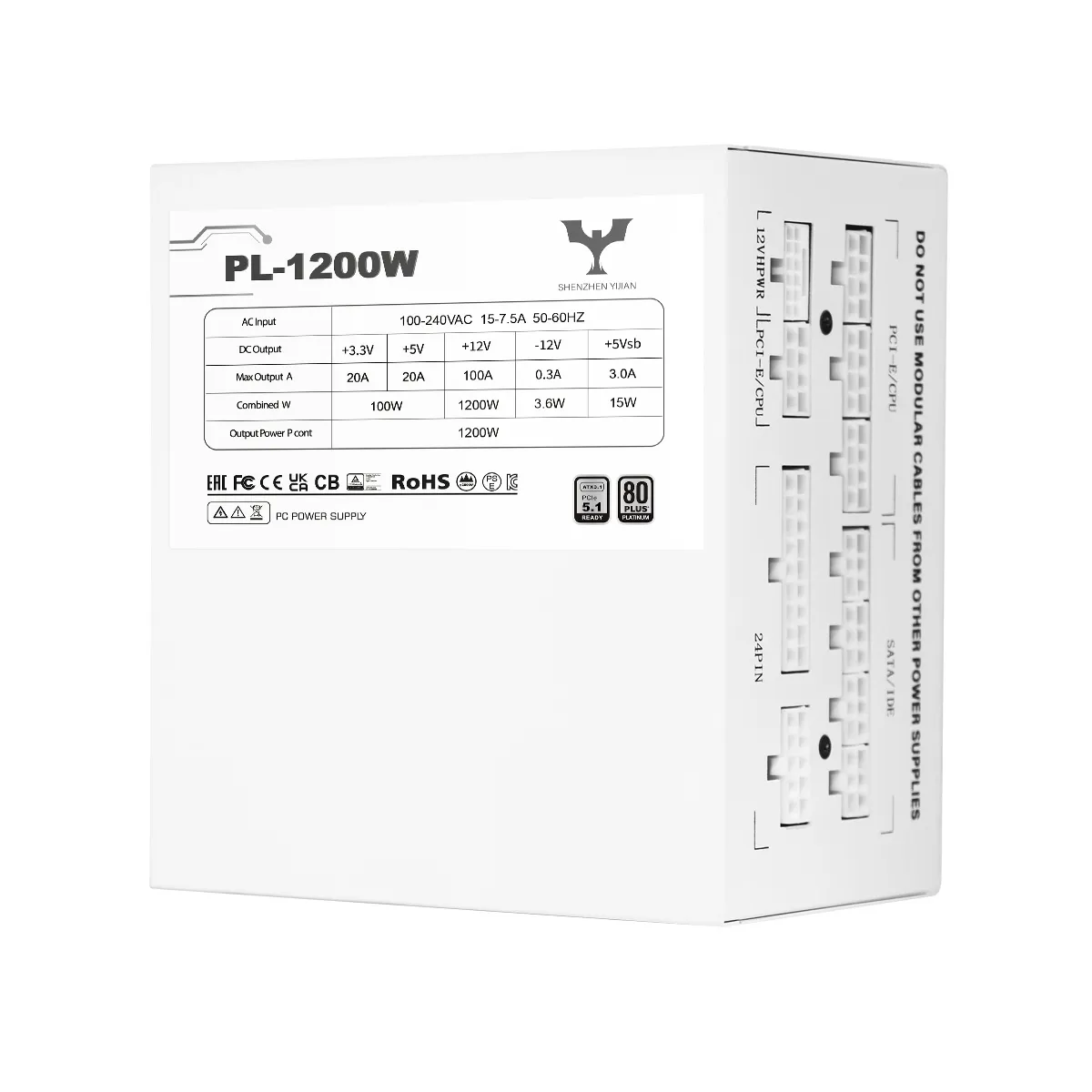
ATX Power Supply Compatibility: Form Factors and Server Chassis Constraints
ATX vs. EPS: Why Standard ATX Power Supplies Require Careful Validation for Server Use
Standard ATX power supplies are engineered for desktop workloads—not the sustained, high-current demands of server environments. The EPS (Entry-Level Power Supply) specification extends ATX with tighter voltage regulation tolerances, lower ripple limits, and mandatory support for dual 8-pin EPS12V connectors. Most server motherboards require two EPS12V inputs for stable CPU power delivery; a standard ATX unit typically provides only a single 4+4-pin ATX12V connector. Even if physical fit is achieved, insufficient EPS12V support or inadequate 12V rail capacity can lead to system instability, unexpected reboots, or permanent damage under continuous load. Always verify that the PSU explicitly supports EPS12V pinouts and is rated for sustained server-grade operation before deployment.
Mounting, Clearance, and Airflow Fit in 1U/2U Server Enclosures
Server chassis—particularly 1U and 2U rackmount models—impose stringent dimensional and thermal constraints. A standard ATX PSU measures 150 mm (W) × 86 mm (H) × 140 mm (D), but many server enclosures require shorter units (100–130 mm depth) to accommodate drive bays, PCIe risers, or rear cooling fans. More critically, airflow direction must align with chassis design: servers typically rely on front-to-back airflow, while many ATX PSUs draw air from the bottom or side—disrupting system-level ventilation and risking hot-air recirculation. Confirm compatibility across mounting screw positions, internal cable clearance, and fan orientation relative to the chassis ventilation path. Misalignment here can trigger thermal throttling, fan over-speed events, or automatic shutdowns—even if electrical specs appear sufficient.
ATX Power Supply Performance: Wattage, Efficiency, and 24/7 Load Stability
Calculating Real-World Power Needs with Derating and Headroom for Continuous Operation
Selecting an ATX PSU for server use requires moving beyond nameplate wattage. Servers operate continuously, accelerating component aging—electrolytic capacitors lose capacitance, fan bearings wear, and voltage regulation drifts over time. As a result, a PSU rated for 500 W at 25°C may deliver only ~400 W reliably at 60°C ambient. Industry best practice applies a 20–30% headroom buffer above measured peak component draw. For example, if your CPU, memory, drives, and expansion cards collectively draw 600 W under full load, select a unit rated for at least 750–800 W. This margin accommodates startup surges, future upgrades, and thermal derating—keeping the PSU outside over-current protection thresholds. Additionally, aim for steady-state operation between 40–70% of rated capacity: this range delivers peak efficiency, lowest heat generation, and longest service life. Ignoring derating is the most common cause of premature PSU failure in 24/7 deployments.
80 PLUS Titanium vs. Gold: Efficiency Gains That Matter Under Sustained Server Loads
Efficiency isn’t just about energy savings—it directly affects thermal load, cooling requirements, and total cost of ownership. The 80 PLUS certification measures AC-to-DC conversion efficiency at defined load points. While both Gold and Titanium units meet minimum thresholds at 50% and 100% load, Titanium excels where servers actually operate: light-to-moderate sustained loads.
| Load Level | 80 PLUS Gold | 80 PLUS Titanium |
|---|---|---|
| 10% | Not rated | 90% |
| 20% | 87% | 92% |
| 50% | 90% | 94% |
| 100% | 87% | 91% |
In a typical 24/7 server drawing 400 W from a 700 W-rated supply, Titanium reduces waste heat by ~20 W compared to Gold—translating to ~175 kWh/year per unit. Across a 100-server rack, that’s nearly 17,500 kWh annually—plus reduced strain on CRAC units and lower data center cooling costs. Though Titanium PSUs carry a 20–30% premium, payback periods in high-availability or high-density deployments typically fall within two to three years. For mission-critical infrastructure, Titanium isn’t optional—it’s foundational.
ATX Power Supply Reliability: Component Quality and Thermal Endurance
Japanese Capacitors and High-Temp Design: Critical for 60°C+ Server Environments
Server-grade ATX PSUs must endure ambient temperatures routinely exceeding 60°C—conditions that rapidly degrade standard electrolytic capacitors rated for 85°C or less. Capacitor failure is the leading cause of premature PSU death in dense racks. Server-optimized units use Japanese-sourced, 105°C-rated (or higher) capacitors that retain stable ESR and capacitance over extended periods, ensuring consistent voltage delivery and multi-year reliability under full load. Equally vital is thermal architecture: oversized heatsinks, double-sided PCB layouts, and intelligent fan curves that prioritize airflow across MOSFETs and transformers—not just overall case temperature. In space-constrained 1U/2U enclosures, even minor thermal misalignment can cascade into throttling or shutdowns. Selecting a PSU validated for continuous operation at 60°C+ ambient—and built with rigorously tested high-temp components—ensures uptime resilience when cooling systems are stressed during summer peaks or partial failures.
ATX Power Supply Connectivity and Protection Features for Server Workloads
A server-ready ATX PSU must provide robust, purpose-built connectivity and layered protection. Essential connectors include the 24-pin main ATX, dual 8-pin EPS12V for CPU power, and multiple high-amperage PCIe cables for GPUs or accelerators. Critical safety features—Over Voltage Protection (OVP), Under Voltage Protection (UVP), Short Circuit Protection (SCP), and Over Current Protection (OCP)—must be implemented at the circuit level, not just as firmware alerts. Fully modular cabling is strongly recommended: it eliminates unused wires, improves airflow, simplifies cable routing in tight chassis, and reduces internal heat buildup. These features collectively ensure clean, stable power delivery and prevent cascading hardware damage during grid fluctuations, transient surges, or internal faults—key safeguards for unattended, always-on server operation.
ATX Power Supply Long-Term Viability: Warranty, Support, and Failure Transparency
A server-grade ATX PSU is a long-term infrastructure investment—not a disposable component. Reputable manufacturers offer warranties ranging from three to ten years; longer coverage reflects confidence in thermal design, capacitor longevity, and real-world 24/7 validation. While well-engineered units often exceed warranty life, aging components—especially electrolytics and fan bearings—begin increasing failure risk after five to seven years in continuous operation. Beyond warranty length, evaluate vendor responsiveness: timely technical support and clear compatibility documentation reduce deployment delays and troubleshooting downtime. Crucially, look for transparency around reliability—vendors that publish failure rate data, recall histories, or root-cause analyses enable proactive lifecycle planning. Combine this with routine monitoring of internal temperatures and input/output voltages, and implement scheduled replacement every 6–8 years for mission-critical systems. Waiting for failure rarely saves cost—it guarantees disruption.
FAQ
Q: Why are standard ATX power supplies not suited for server use?
A: Standard ATX power supplies lack the EPS12V support and sustained current capacity required for server workloads, leading to instability and potential hardware damage during continuous operation.
Q: How does thermal derating impact power supply selection?
A: Thermal derating reduces a power supply’s effective capacity at higher temperatures. For example, a PSU rated at 500 W at 25°C may only reliably deliver ~400 W at 60°C, necessitating additional headroom in server environments.
Q: What are the differences between 80 PLUS Gold and Titanium efficiency ratings?
A: Titanium PSUs are more efficient than Gold units, particularly at light-to-moderate load levels. This efficiency reduces heat generation and energy costs over sustained operation.
Q: Why are Japanese capacitors recommended for server-grade PSUs?
A: Japanese capacitors rated for 105°C or higher ensure long-term reliability and stable performance in high-temperature environments, which are common in server setups.
Q: What safety features are essential in server-ready PSUs?
A: Essential safety features include Over Voltage Protection (OVP), Under Voltage Protection (UVP), Short Circuit Protection (SCP), and Over Current Protection (OCP) to safeguard components during power fluctuations or faults.
Q: How long can I expect a server-grade PSU to last?
A: Server-grade PSUs typically last 6–8 years in continuous operation, though aging components may necessitate replacement around the five-to-seven-year mark in critical deployments.
Table of Contents
- ATX Power Supply Compatibility: Form Factors and Server Chassis Constraints
- ATX Power Supply Performance: Wattage, Efficiency, and 24/7 Load Stability
- ATX Power Supply Reliability: Component Quality and Thermal Endurance
- ATX Power Supply Connectivity and Protection Features for Server Workloads
- ATX Power Supply Long-Term Viability: Warranty, Support, and Failure Transparency
- FAQ