 EN
EN

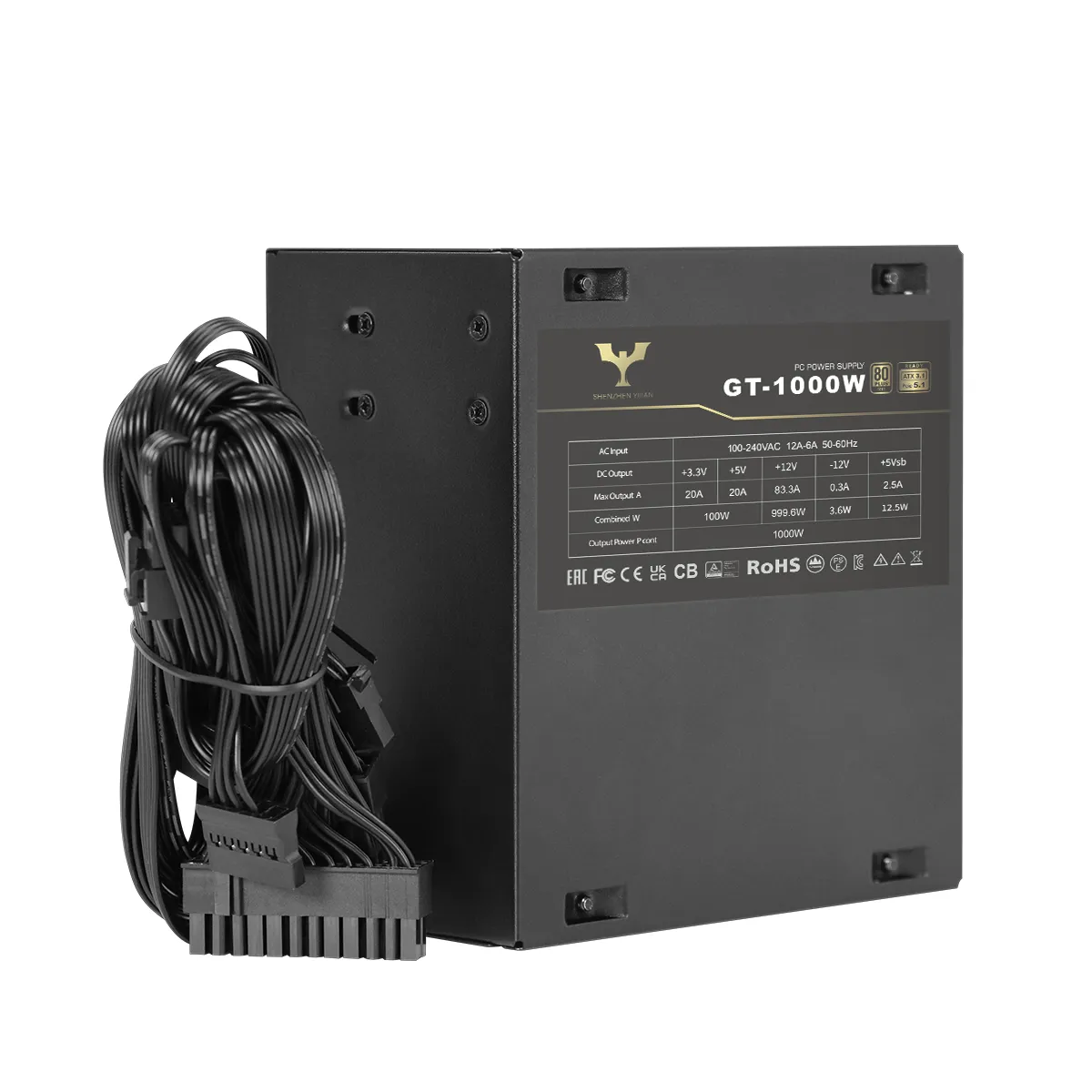
Understanding Server Power Supply Unit Efficiency and Certification
Decoding 80 Plus Ratings: From Bronze to Titanium for Data Center Efficiency
Server power supply units (PSUs) convert AC power to DC power for server components—but energy loss occurs during conversion. The 80 PLUS certification program quantifies efficiency through standardized testing at 20%, 50%, and 100% loads. Higher tiers reflect progressively better energy utilization:
| 80 PLUS Tier | 20% Load Efficiency | 50% Load Efficiency | 100% Load Efficiency |
|---|---|---|---|
| Bronze | 82% | 85% | 82% |
| Silver | 85% | 89% | 85% |
| Gold | 87% | 90% | 87% |
| Platinum | 90% | 92% | 89% |
| Titanium | 94% | 96% | 91% |
Each 1% efficiency gain reduces power loss by approximately 10 watts per kilowatt consumed. Platinum and Titanium PSUs generate 30–50% less heat than Bronze equivalents—cutting cooling costs and extending hardware lifespan. According to 2023 hyperscaler efficiency reports, data centers using Titanium-certified PSUs achieve 12–18% lower annual energy expenditures.
Why Titanium-Certified Power Supply Units Are Critical for AI and High-Density Servers
Modern AI training servers and GPU-dense systems experience extreme power fluctuations between idle and peak computation. Titanium-certified PSUs maintain ≥94% efficiency even at 10% load—a critical threshold where Bronze and Silver units fall below 85%. This stability prevents voltage irregularities during sudden workload spikes, thermal throttling in 40kW+ racks, and harmonic distortion affecting adjacent equipment.
Titanium’s 96% peak efficiency reduces per-rack energy losses by $740k annually (Ponemon Institute, 2023). The certification mandates redundant DC-DC converters and server-grade capacitors—delivering the precise, stable power envelope required by sensitive AI accelerators and high-throughput storage arrays.
Redundancy, Reliability, and Protection Features in Server Power Supply Units
A server PSU must deliver consistent, clean power under all conditions. Redundancy models and integrated protection features directly determine uptime, hardware longevity, and operational resilience. Without them, a single component failure can cascade into full system outage.
N+1 and 2N Redundancy Models: Ensuring Zero-Downtime Power Delivery
Redundant configurations eliminate single points of failure. Two architectures dominate enterprise deployments:
| Model | Description | Typical Uptime |
|---|---|---|
| N+1 | One extra PSU beyond minimum requirement; load is shared across all units. | 99.999% (five nines) |
| 2N | Two independent, fully parallel power paths—each capable of carrying 100% load. | 99.9999% (six nines) |
In N+1, failure of one unit triggers automatic load redistribution without interruption. Hot-swappable design allows replacement without server shutdown. 2N goes further: faults are isolated to one path, enabling safe maintenance on an entire power chain. Both rely on real-time load balancing to prevent thermal stress and optimize efficiency.
Key Reliability Drivers: Active PFC, Overvoltage/Overcurrent Protection, and Intelligent Thermal Management
Beyond redundancy, built-in safeguards protect both the PSU and downstream hardware. Active Power Factor Correction (PFC) maintains a power factor >0.9, minimizing harmonic distortion and improving grid efficiency. Overvoltage (OVP) and overcurrent (OCP) protection cut power within microseconds if thresholds are exceeded—preventing irreversible damage to CPUs, GPUs, or memory. Intelligent thermal management, using variable-speed fans and multi-zone temperature sensors, dynamically adjusts cooling to keep components within optimal operating ranges. This extends PSU service life, reduces acoustic noise, and sustains performance under sustained loads.
Server-Specific Power Supply Unit Design: Compatibility and Longevity
Wattage Scalability, Form Factor (EPS12V, CRPS), and Connector Standards for Modern Server Racks
Server PSUs differ fundamentally from desktop units. They use purpose-built form factors like EPS12V (for single-socket workloads) and CRPS (Common Redundancy Power Supply), engineered for hot-swap compatibility in rack-mounted infrastructure. Wattage scalability is essential: enterprise servers demand 750W–2000W capacity to support dual CPUs, large memory banks, NVMe storage arrays, and multiple GPUs. Connector standards—including 12V-only outputs, PCIe 5.0 12VHPWR, and SATA/Molex variants—ensure seamless integration with modern motherboards and backplanes. Always verify chassis compatibility before deployment to avoid electrical mismatches or mechanical interference.
Lifespan Expectations, Extended Warranties, and How Component Quality Impacts Power Supply Unit Failure Rates
Server PSUs operate under constant thermal and electrical stress, resulting in typical lifespans of 3–5 years. Heat is the leading degradation factor: every 10°C rise above rated ambient can halve capacitor life. Industrial-grade components—including Japanese electrolytic capacitors, reinforced MOSFETs, and conformal-coated PCBs—significantly mitigate wear. Premium units with these features demonstrate 40% lower annualized failure rates (AFR) than entry-level alternatives (Uptime Institute, 2022). Extended warranties (5–7 years) signal manufacturer confidence in durability. To maximize longevity, operate PSUs within 40–80% of rated load and ensure adequate airflow—avoiding sustained operation near thermal or electrical limits.
How to Evaluate and Select the Best Power Supply Unit for Your Server Environment
Selecting the right PSU requires evaluating five interdependent criteria—not just wattage. First, calculate total system power draw using vendor-specified TDPs (not theoretical peaks), then add a 20–30% buffer for transient spikes and future expansion. Second, prioritize 80 PLUS Titanium or Platinum efficiency: these reduce OPEX by 8–12% versus Bronze units (Uptime Institute, 2023) while cutting heat-related cooling overhead.
Third, align redundancy with business-criticality: N+1 delivers cost-effective fault tolerance for most production environments; 2N is reserved for zero-RTO applications like financial transaction engines or real-time AI inference clusters. Fourth, confirm physical compatibility—form factor (CRPS/EPS12V), mounting depth, connector count, and cable routing clearance must match your chassis specifications. Fifth, assess durability signals: MTBF ratings ≥100,000 hours, Japanese capacitors, and 5+ year warranties correlate strongly with field reliability.
Combine these into a balanced selection matrix:
| Evaluation Factor | Critical Metrics | Business Impact |
|---|---|---|
| Power Capacity | Wattage + 30% buffer | Prevents overloads during spikes |
| Efficiency | 80 Plus Titanium/Platinum | 8–12% lower OPEX (Uptime Institute 2023) |
| Redundancy | N+1 vs. 2N models | Directly affects SLA compliance |
| Compatibility | Form factor + connectors | Eliminates deployment delays |
| Durability | MTBF + warranty length | Reduces replacement costs by 34% |
This approach balances technical rigor with operational economics—ensuring reliable, scalable, and energy-efficient power delivery. Always validate against measured load profiles, not spec-sheet maxima.
FAQ Section
Q: What is the 80 PLUS certification and its importance?
A: The 80 PLUS certification quantifies a PSU's energy efficiency at various load levels. Higher certifications like Titanium reflect better efficiency, reduced power loss, and lower operational costs.
Q: How does redundancy in server PSUs ensure uptime?
A: Redundancy configurations like N+1 and 2N provide fail-safe mechanisms, ensuring uninterrupted power delivery even if a PSU unit fails.
Q: Why is Titanium certification ideal for AI workloads?
A: Titanium-certified PSUs maintain high efficiency even during extreme power fluctuations, which is critical for GPU-intensive AI and high-density servers.
Q: What factors affect PSU lifespan, and how can it be extended?
A: Heat and constant electrical stress are major factors affecting PSU lifespan. Using industrial-grade components, maintaining ideal airflow, and operating within 40-80% load can extend lifespan.
Q: How do I select the right PSU for my server?
A: Evaluate system power draw, efficiency tier, redundancy needs, physical compatibility, and durability metrics like MTBF and warranty length.