 EN
EN

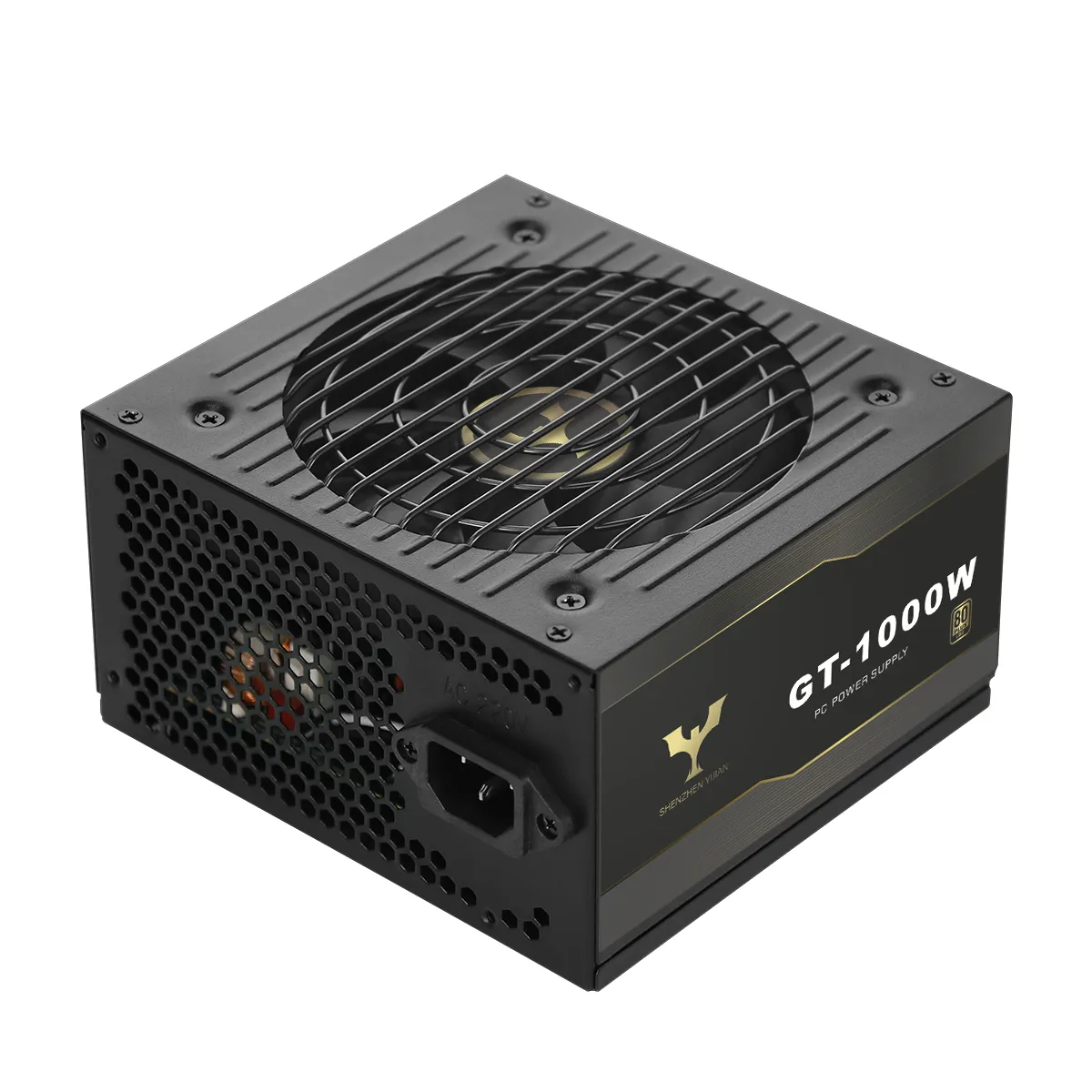
SFX Power Supply Fundamentals: Form Factor, Standards, and Key Differences
SFX vs. ATX: Physical dimensions, mounting layout, and chassis integration
The core distinction between SFX and ATX power supplies lies in their physical profiles. SFX units measure 125mm × 63.5mm × 100mm, making them 45% smaller by volume than standard ATX models (150mm × 86mm × 140–230mm). This compactness enables integration into SFF (Small Form Factor) cases—but demands careful clearance planning for cable routing near the PCIe bracket, GPU interference, and cooling conflicts—especially with longer SFX-L variants (130mm depth).
SFX PSUs require an adapter bracket for ATX chassis due to incompatible screw patterns. This mechanical divergence creates clear tradeoffs:
| Parameter | SFX Power Supply | ATX Power Supply |
|---|---|---|
| Volume | 0.8 liters | 1.8–2.5 liters |
| Typical Wattage | ≤ 1000W | ≤ 3000W |
| Fan Size | 92mm (higher RPM/noise) | 120–140mm (lower RPM) |
While SFX enables ultra-compact builds, ATX delivers superior thermal headroom—allowing lower fan speeds under sustained load, a key advantage for high-TDP systems (Ponemon 2023).
SFX12V 3.0 specification: Electrical compliance, efficiency requirements, and mechanical tolerances
The SFX12V 3.0 standard defines strict electrical and mechanical requirements beyond size. Voltage rails must maintain ±3% deviation on 12V and 5V outputs during 100% load transients—a threshold validated using tools like HWiNFO or a calibrated multimeter. Efficiency must meet at least 80 PLUS Gold certification (≥90% at 50% load), with Platinum increasingly common in premium SFX units to mitigate thermal stress in confined enclosures.
Mechanical tolerances include:
- Connector placement precision within ±0.5mm
- Front-panel switch alignment compatibility
- Backplate cutout accuracy for modular cable management
All compliant units integrate robust OPP (Over Power Protection) and OVP (Over Voltage Protection), triggering at 120–150% of rated capacity—an essential safeguard against hardware damage in thermally constrained SFF environments.
Physical Installation Check: Ensuring Your SFX Power Supply Fits the Case
Before powering on your system, verifying the physical fit of your SFX power supply within the case is non-negotiable. An incompatible installation risks component damage, compromised airflow, or failure to mount securely.
Clearance verification: Depth, height, width, and PCIe bracket or cable routing conflicts
Measure internal chassis space against your SFX PSU’s dimensions—125mm (W) × 63.5mm (H) × 100mm (D)—using a caliper or ruler. Confirm clearance for:
- Cable routing: Ensure 24-pin ATX and EPS12V cables route cleanly without pressing against side panels or impeding GPU installation.
- Adjacent components: Check for interference with long GPUs, tall CPU coolers, or drive cages—insufficient depth may prevent rear-panel alignment or block exhaust vents.
- Ventilation paths: Maintain ≥25mm clearance around intake and exhaust openings to avoid thermal throttling. Note that ATX cases often require SFX-to-ATX adapter brackets, adding 10–15mm to effective depth.
Mounting compatibility: Hole alignment, screw thread standards (M3/M4), and bracket adaptability
SFX PSUs use four M4 screws (3.5mm thread diameter) on the rear flange. Validate:
- Hole alignment: Match PSU screw holes precisely to chassis mounting points—misalignment places dangerous mechanical stress on the PCB.
- Bracket necessity: ATX cases require conversion brackets; confirm compatibility with your specific model. Native SFX mounts are standard in purpose-built SFF cases (e.g., Fractal Design Node 202, Silverstone RVZ series).
- Tolerance gaps: Allow 0.5–1mm play for thermal expansion. Do not overtighten M4 screws beyond 0.6 N·m torque, as excessive force can fracture the housing.
Electrical and System-Level Compatibility Testing for SFX Power Supplies
Voltage rail validation: Measuring 12V, 5V, and 3.3V stability under load with a multimeter
Validate voltage stability by measuring the 12V, 5V, and 3.3V rails on the 24-pin ATX connector while the system is under realistic load. Set your multimeter to DC voltage mode and probe corresponding pins during idle, 50%, and 100% system utilization. Industry standards (ATX12V v2.51+) require rails to stay within ±5% deviation, with the 12V rail critical for stability—maintaining 11.4V–12.6V under peak load. Consistent droop beyond this range signals potential incompatibility with high-end motherboards or GPUs.
Functional stress testing: Using OCCT, HWiNFO, or dummy loads to verify sustained output and protection triggers
Stress-test your SFX PSU using OCCT (Power Supply test), HWiNFO (real-time sensor logging), or a dedicated dummy load tester. Run tests for 30+ minutes to simulate worst-case thermal and electrical conditions. Monitor for:
- Voltage ripple exceeding 120mV on the 12V rail, indicating poor filtering or aging capacitors
- Premature thermal shutdown before reaching the unit’s rated temperature threshold (typically 105°C internal)
- Failure to activate over-current protection (OCP) during controlled short-circuit simulation
Dummy load testers also verify whether the unit sustains its claimed 80 PLUS efficiency across 20%, 50%, and 100% loads—confirming real-world performance aligns with certification. Units passing these benchmarks demonstrate proven reliability with modern high-wattage CPUs and GPUs.
FAQ
Q: What is the primary difference between SFX and ATX power supplies?
A: SFX power supplies are smaller, measuring 125mm × 63.5mm × 100mm, and are designed for compact SFF cases. ATX PSUs are larger and offer higher wattage and better thermal headroom.
Q: Can I use an SFX power supply in an ATX case?
A: Yes, but you will need an adapter bracket to mount the SFX power supply securely in an ATX case.
Q: How do I measure if an SFX PSU fits my case?
A: Use a caliper or ruler to verify your case's internal dimensions against the SFX PSU's size (125mm × 63.5mm × 100mm). Check for clearance around cables, GPUs, and other components.
Q: What efficiency standard should I look for in SFX power supplies?
A: Look for at least 80 PLUS Gold certification, though higher standards like Platinum are preferable for premium builds to reduce thermal stress.
Q: How do I test the electrical stability of my SFX power supply?
A: Use a multimeter to measure voltage rails (12V, 5V, and 3.3V) while the system is under load. Ensure deviations remain within ±5% of the standard voltages.